

Traditional Archery in Sundanese, Javanese, and Korean Cultures as Character Education and Global Citizenship Education
Dr. Dasim Budimansyah
Director, GCC Indonesia
Professor of Sociology of Citizenship
Universitas Pendidikan Indonesia
Imagine three archers standing—or sitting—in three distant cultural settings. A Sundanese archer sits with a Panah Kasumedangan bow in his hands. In Yogyakarta, a Jemparingan archer draws his gandewa while focusing his mind. Thousands of kilometres to the north, a Korean archer stands on a hwalssogi field, drawing a traditional bow through movements passed down from generation to generation.
Their bows are different. Their techniques are different. Even the distances to their targets are different. They come from different histories and cultural traditions.
Yet something connects all three: before an arrow is directed towards an external target, the archer must first bring order to something within.
The archer must regulate the body, calm the mind, control emotions, focus attention, respect the rules, and ultimately take responsibility for the arrow that has been released.
Traditional archery, therefore, should not be understood merely as a surviving technology of hunting or warfare. Over the course of cultural development, the bow and arrow underwent a remarkable transformation: from instruments used to overcome others into means of mastering oneself.
It is at this point that Panah Kasumedangan in Sundanese culture, Jemparingan in Javanese culture, and hwalssogi, or traditional Korean archery, become highly relevant to character education and Global Citizenship Education (GCED).
From Weaponry to Self-Education
The bow and arrow were originally technologies of survival. People used them for hunting, self-defence, and warfare. Yet societies did not simply pass down the physical objects. They also developed meanings around how those objects should be used.
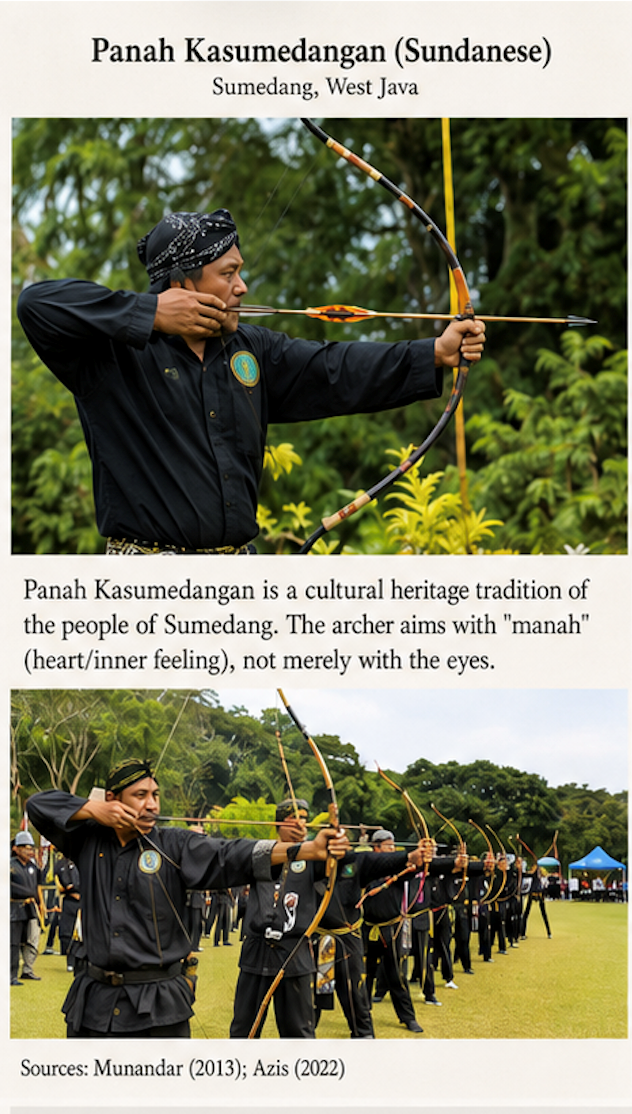
Within Sundanese culture, one such tradition survives in Panah Kasumedangan. Local traditions and documentation connect it with the historical environment of Sumedang Larang. In Kampung Cimanglid, Rancakalong, for example, Panah Kasumedangan has been documented as one of the cultural practices maintained by the local community (Munandar, 2013). In 2022, the Sumedang Regency Government also established a study team on Panah Kasumedangan as part of efforts to document this cultural heritage.
Nevertheless, claims about exactly when Panah Kasumedangan emerged as a distinct archery system should be approached with caution. Much of the available account of its origins comes from the oral traditions of local communities and cultural practitioners. It is therefore more appropriate to say that the people of Sumedang preserve a cultural memory linking Panah Kasumedangan to the warrior tradition of Sumedang Larang, rather than to establish prematurely a fixed historical origin that has not yet been fully supported by primary sources.
What is particularly fascinating, however, is the meaning attached to the tradition today. One practitioner of Panah Kasumedangan explains that aiming is not done merely with the eyes, but also with manah—the heart or inner feeling. This gives rise to a symbolic distinction between manah and manon: one does not simply look at the target but seeks to sense the direction and appropriateness of the action (Azis, 2022).
This interpretation is important. We do not need to treat it as a historically established etymology in order to appreciate its pedagogical significance. Manah can be understood as a metaphor suggesting that appropriate action begins with an ordered inner self.
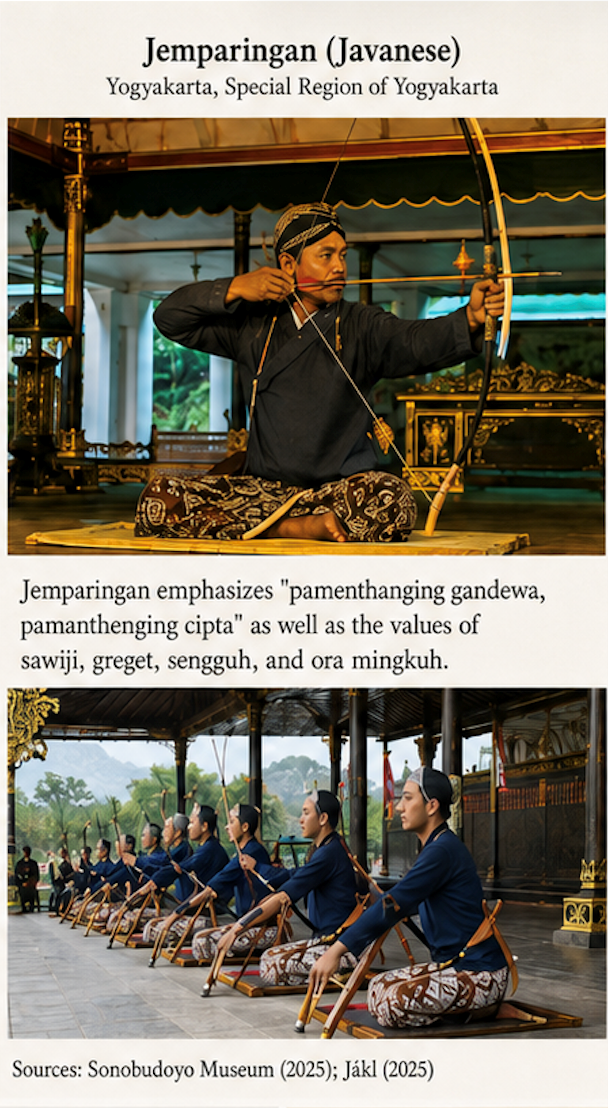
The Javanese tradition of Jemparingan Mataraman offers a similar idea, though in a more explicit philosophical form. Jemparingan, which developed within the cultural environment of the Yogyakarta Sultanate, is traditionally practised while sitting cross-legged and places considerable emphasis on concentration and inner feeling when aiming. The tradition is associated with the cultivation of knightly character and the values of sawiji, greget, sengguh, and ora mingkuh: focus, determination, self-confidence without arrogance, and a willingness to fulfil one’s responsibilities. Its philosophy is captured in the expression pamenthanging gandewa, pamanthenging cipta—to draw the bow while simultaneously focusing the mind (Museum Sonobudoyo, 2025).
Jákl’s (2025) research further suggests that the history of target archery in Java is much older than the form of Jemparingan now associated with the Mataram-Yogyakarta tradition. Textual, visual, and archaeological evidence indicates that practices of shooting arrows at designated targets already existed in pre-Islamic Java. Jemparingan may therefore be understood as part of a much longer cultural journey through which Javanese society gave meaning to the skill of archery.
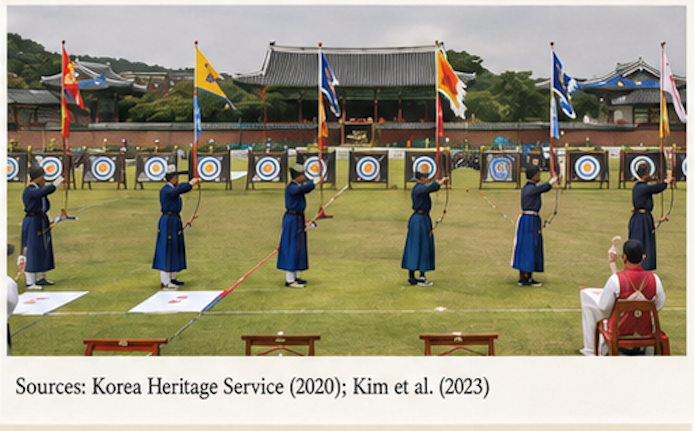
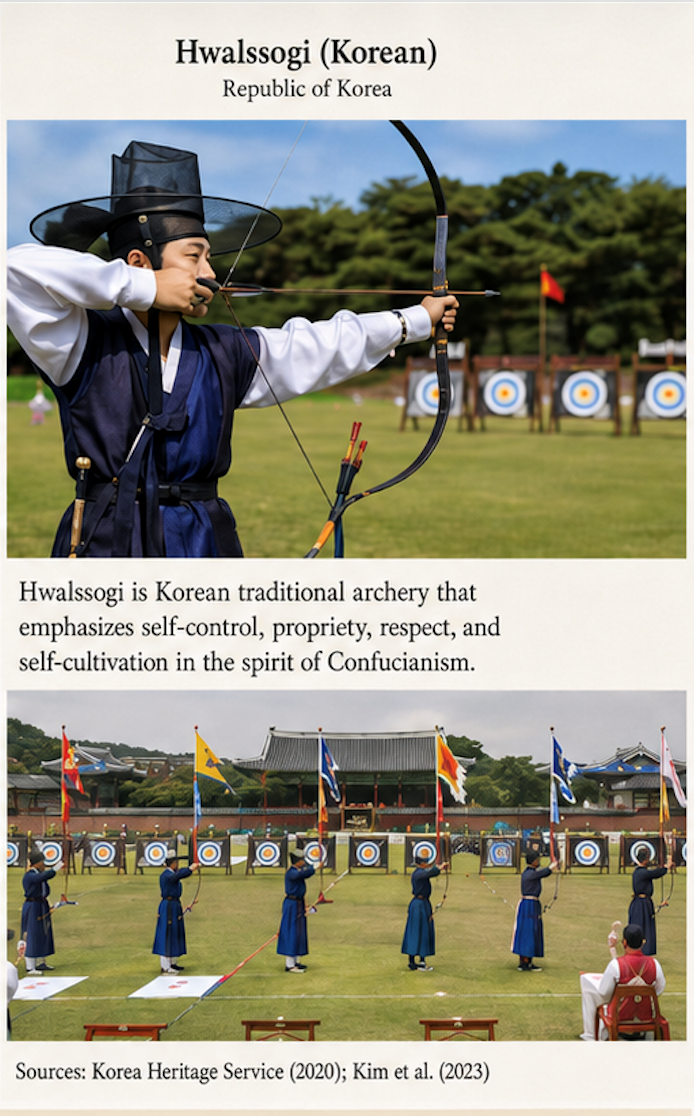
In Korea, a broadly parallel development can be found in hwalssogi (활쏘기), the Korean term for traditional archery. The South Korean government designated it a National Intangible Cultural Heritage on 30 July 2020. The tradition has a long history as a hunting and military skill, but over time it developed strong social, ritual, and educational dimensions.
During the Joseon period, archery was not regarded merely as a physical skill. It was connected to the Confucian tradition of self-cultivation. The National Folk Museum of Korea notes that learned members of society practised archery not only to train the body and mind but also to cultivate virtue. Communal archery also became a means of strengthening social relationships (National Folk Museum of Korea, n.d.).
Kim, Kang, and Kwon (2023) reinforce this interpretation. They argue that the philosophy of Korean traditional archery can be understood through Confucian principles of self-control and the restoration of propriety, together with the value of respect. More recent research also highlights the integration of physical discipline, concentration, moral cultivation, and communal ethics within Korean traditional archery (Wu & Ok, 2026).
Thus, in Sumedang, Yogyakarta, and Korea, we can see a broadly similar cultural transformation: a weapon becomes a practice of education.
Manah, Cipta, and Self-Control
What is an archer actually training?
At first glance, the answer seems simple: accuracy in hitting a target.
Yet archery presents an interesting paradox. The more a person becomes obsessed with the external target, the more easily control of the self may be lost. The hands become tense, breathing changes, concentration weakens, and the arrow misses its mark.
Reaching an external target therefore requires inner order.
Panah Kasumedangan symbolises this through manah. Jemparingan expresses it through pamanthenging cipta. Korean archery formulates it through self-control, propriety, respect, and self-cultivation.
The three traditions can be summarised through a common educational sequence:
regulating the body → focusing attention → exercising self-control → determining direction → taking action → accepting the consequences.
This is where traditional archery can be understood as a form of embodied character education.
Character is not merely discussed. It is practised.
Patience is not simply taught through words; it is experienced when the archer waits for the appropriate moment. Focus is not merely defined; it is practised when attention is directed towards the target. Self-control is not simply a moral concept; it becomes real when an archer resists the urge to release the arrow before both body and mind are ready. Responsibility becomes tangible because once an arrow has been released, it cannot be called back.
This perspective is consistent with Lickona’s (1991) view that good character involves moral knowing, moral feeling, and moral action. Character education loses much of its power when it stops at knowledge about values. Values must also be felt and translated into action.
Traditional archery provides a space in which these three dimensions come together.
From Character Education to Civic Sensibility
One of the major challenges facing contemporary citizenship education is precisely the gap between knowledge and action.
We know that violence is wrong, yet violence continues. We know that hatred can damage social life, yet hate speech continues to be produced and circulated. We understand the importance of tolerance, justice, environmental sustainability, and peace, but such knowledge does not always lead to corresponding behaviour.
This is what I call the civic knowledge–action paradox: the gap between what citizens know and what they actually do (Budimansyah, 2026).
What is needed to bridge this gap is civic sensibility—a form of civic sensitivity that moves a person from knowing to feeling, from feeling to caring, from caring to experiencing a moral calling, and eventually from moral concern to civic action. Citizens, in other words, do not only need knowledge about what is right. They also need the sensitivity to read situations, recognise how their actions may affect others, and regulate themselves before acting.
This is where the philosophy of archery becomes especially relevant.
The arrow represents the capacity to act. Manah represents the moral sensibility that gives direction to action.
A person may possess extraordinary abilities, advanced technology, considerable power, and extensive knowledge. Yet without manah—without moral sensitivity—those capacities can easily be directed towards the wrong target.
Citizenship education should therefore not merely produce citizens who are “good at shooting arrows.” Education must develop people who are capable of asking:
Why am I releasing this arrow? At whom or what is my action directed? Who will be affected by it? Is this action just? Does it nurture our shared life, or does it harm it?
These are fundamentally civic questions.
The Arrow Released into the World
The relevance of these three traditions becomes even clearer when they are placed within the framework of Global Citizenship Education.
UNESCO (2015) identifies three interconnected domains of GCED: cognitive, socio-emotional, and behavioural. The cognitive domain concerns knowledge and the ability to understand the complexity of the world. The socio-emotional domain includes values, empathy, solidarity, respect for diversity, and a sense of belonging to a common humanity. The behavioural domain concerns the ability to act effectively and responsibly at local, national, and global levels.
This structure has a striking resonance with the pedagogy embedded in traditional archery.
Knowing the target belongs to the cognitive domain.
Feeling, calming oneself, respecting others, and controlling the ego belong to the socio-emotional domain.
Releasing the arrow and taking responsibility for its consequences belong to the behavioural domain.
Panah Kasumedangan, Jemparingan, and hwalssogi can therefore be understood not simply as cultural objects that should be preserved in museums, but as pedagogical resources capable of connecting knowledge, feeling, and action.
UNESCO’s 2023 Recommendation on education for peace, human rights, international understanding, global citizenship, and sustainable development further emphasises that education does not take place only in classrooms. It takes place across different environments of life and should help people become agents of peace (UNESCO, 2023).
From this perspective, even an archery field can become a space for citizenship education.
Rooted Locally, Open to the World
There is sometimes an assumption that becoming a global citizen means moving further away from one’s local identity. This assumption needs to be reconsidered.
Global citizenship is not a project of cultural uniformity. It is not a process through which Sundanese, Javanese, Korean, Japanese, African, or European people are expected to abandon their cultural roots in order to become culturally indistinguishable “global” individuals.
GCED can instead grow through our ability to discover universal values within particular cultural experiences.
Panah Kasumedangan teaches manah.
Jemparingan teaches the focusing of cipta, together with sawiji, greget, sengguh, and ora mingkuh.
Korean traditional archery teaches self-control, propriety, respect, self-cultivation, and communal ethics.
Their languages are different, but their moral messages converge: human beings must learn to master themselves before exercising their power upon the world.
From here, culturally grounded character education can move towards global citizenship:
self → others → community → nation → humanity
A person first learns to govern the self, then to respect others, to live responsibly within the community, to fulfil responsibilities as a citizen of a nation, and ultimately to develop solidarity with humanity beyond national borders.
Becoming a citizen of the world, therefore, does not require people to be uprooted from the cultural soil in which they have grown. On the contrary, healthy local roots can provide a point of departure for understanding universal humanity.
We Should Not Romanticise Tradition
At the same time, we should avoid romanticising the past.
Not every tradition automatically develops good character. Cultural practices may lose their deeper meaning when they become merely spectacles, competitions, or symbols of identity. Traditions may also contain elements of hierarchy, exclusivity, or historical practices that do not fully correspond with contemporary values of democracy, equality, and human rights.
What is needed, therefore, is not merely preservation, but pedagogical transformation.
Young people should not simply be invited to hold a bow, wear traditional clothing, and release an arrow. They should also be encouraged to reflect on what the experience means.
Why must I remain calm before releasing an arrow?
What happens when I act without considering others?
Why should an archer respect an opponent?
Why must power be controlled?
What is the relationship between accuracy in aiming and sound judgement in life?
What kinds of “arrows” do we release every day through our words, decisions, exercise of power, consumption choices, and even our social-media posts?
Reflective questions such as these transform cultural practice into an educational experience.
Tradition should not merely be inherited. It should also be reinterpreted to respond to the needs of the present.
Before Aiming at the World
Today’s world places in human hands “bows” far more powerful than those possessed by our ancestors.
Digital technology allows a single sentence to reach millions of people within seconds. Artificial intelligence greatly expands our capacity to produce and distribute information. Economic power can influence the lives of communities across national borders. Individual consumption choices can affect workers and ecosystems on the other side of the planet.
Our arrows now travel faster and farther than ever before.
The question is: has our manah developed as rapidly as the bows we now possess?
It is here that the wisdom of Panah Kasumedangan, Jemparingan, and hwalssogi acquires renewed significance.
Together, these traditions remind us that ability without self-control can become dangerous; accuracy without wisdom can lose its direction; and action without moral sensitivity can harm others.
Character education should train people to master themselves.
Citizenship education should teach people to consider the consequences of their actions for our shared life.
Global Citizenship Education expands that circle of responsibility to other human beings and to the planet we share.
Perhaps, then, the greatest lesson offered by these three archery traditions is not how to hit a target.
Their most important lesson lies in the moment just before the arrow is released—when a person pauses, brings the body into balance, focuses the mind, listens to the manah, considers the direction of the action, and accepts responsibility for whatever follows.
Before aiming at the world, human beings must first learn to master themselves.
And perhaps that is where Global Citizenship Education should begin.
References
Azis, N. (2022, August 23). Mengenal tradisi Panah Kasumedangan. detikJabar.
Budimansyah, D. (2026). Kenapa kita tidak melakukan apa yang kita tahu? Memahami civic knowledge-action paradox dan kekuatan civic sensibility. Jendela Hasanah.
Jákl, J. (2025). Archery and target-shooting in pre-Islamic Java: What can be known? Wacana, Journal of the Humanities of Indonesia, 26(3), Article 8.
Kim, J., Kang, Y.-S., & Kwon, O.-R. (2023). A study on the philosophy of Korean traditional archery. Philosophy of Movement: The Journal of the Korean Society for the Philosophy of Sport, Dance, and Martial Arts, 31(2), 31–41.
Korea Heritage Service. (2020). Hwalssogi (Archery). National Heritage Portal.
Lickona, T. (1991). Educating for character: How our schools can teach respect and responsibility. Bantam Books.
Munandar, A. (2013). Identifikasi potensi budaya dalam pengembangan Desa Pasir Biru sebagai desa wisata di Kabupaten Sumedang [Undergraduate thesis, Universitas Pendidikan Indonesia]. UPI Repository.
Museum Sonobudoyo. (2025, December 16). Jemparingan: Tradisi panahan penuh filosofi dari Yogyakarta. Pemerintah Daerah Daerah Istimewa Yogyakarta.
National Folk Museum of Korea. (n.d.). Archery.
UNESCO. (2015). Global citizenship education: Topics and learning objectives. UNESCO.
UNESCO. (2023). Recommendation on education for peace and human rights, international understanding, cooperation, fundamental freedoms, global citizenship and sustainable development. UNESCO.
Wu, J., & Ok, K. (2026). A study on the systematization of Korean traditional archery from a sport science perspective. Journal of the Korean Society for the Study of Physical Education, 31(1), 343–353.